Advancements in MALE and HALE Drone Technology: Enhancing Established Systems and Integrating New Aircraft Models

The Evolving Role of MALE and HALE Drones in Modern Defense
Introduction to MALE and HALE Drones
Medium-altitude long-endurance (MALE) and high-altitude long-endurance (HALE) drones represent pivotal advancements in military technology, providing vital capabilities for reconnaissance and engagement. These unmanned aerial vehicles (UAVs) are designed for high-altitude flight, facilitating broader detection ranges and enhanced operational versatility compared to traditional aircraft operating in lower airspaces.
The significance of these UAVs lies in their ability to maintain prolonged surveillance, drastically improving situational awareness for commanders. Their deployment enables critical decision-making processes by offering near-real-time intelligence while minimizing risks to personnel.
Characteristics of MALE Drones
Operational Flexibility and Varied Capabilities
MALE drones showcase diverse performance metrics and mission considerations. Typically, these systems can operate at elevations between 7,000 and 15,000 meters, rendering them beneficial in multifaceted military scenarios. This operational altitude provides:
- Extended Detection Range: Enhanced capability to identify and track targets over vast geographical areas.
- Mission Adaptability: The ability to execute varied tasks—from intelligence collection to immediate strike operations—has propelled the MALE segment to prominence among defense planners.
Spotlight on the MQ-9 Family
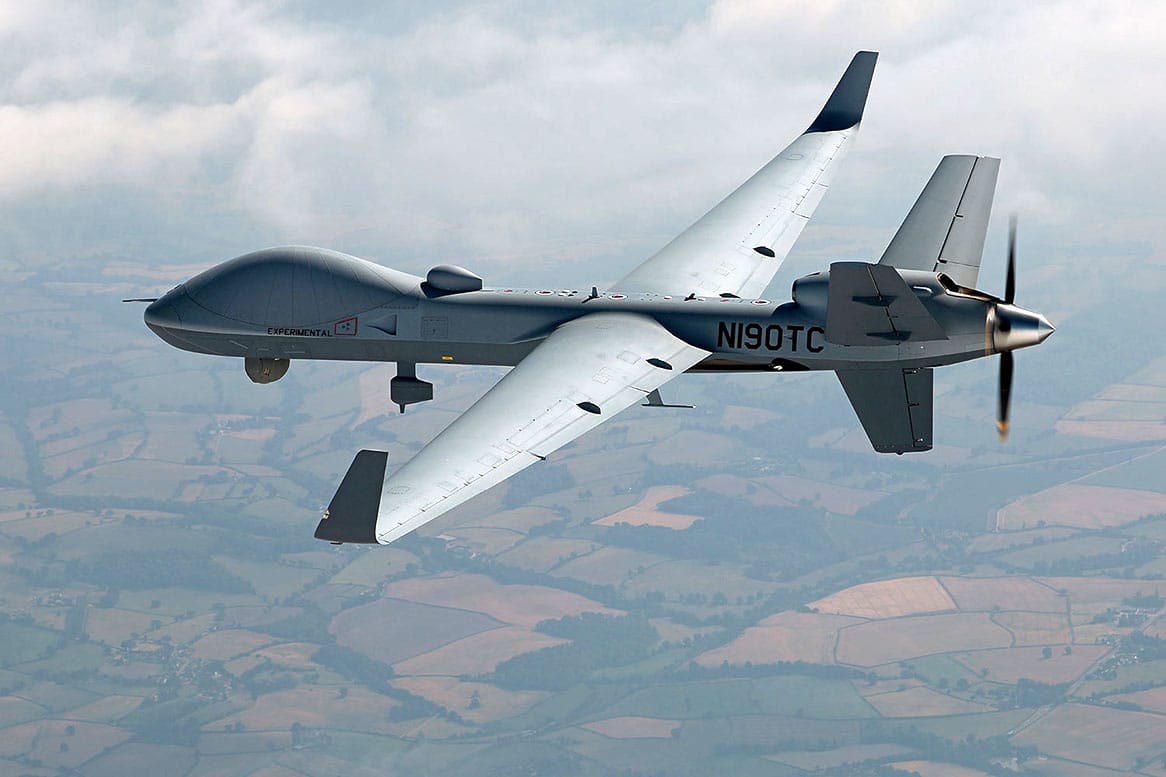
Primarily produced by General Atomics Aeronautical Systems Inc. (GA-ASI), the MQ-9 Reaper series illustrates the effectiveness of MALE UAVs. Although classified as MALE, variants like the MQ-9A reach maximum operational ceilings exceeding 15,000 meters, propelling them towards HALE categorization.
Key Variants of the MQ-9 Family
- MQ-9A Block 5: Ideal for hunt-and-kill missions, this model excels in identifying and swiftly engaging high-value targets. With a wingspan of 20 meters and mission endurance of 27 hours, it integrates sophisticated sensor packages, including synthetic aperture radar (SAR) and electro-optical cameras, enhancing its battlefield effectiveness.
- MQ-9B Guardian: Larger at 24 meters wingspan with a maximum take-off weight of 5,700 kg, it boasts an extended mission endurance of 30-40 hours. Designed to comply with NATO’s operational standards for integration into civil airspace, it features advanced detection systems that facilitate seamless operations alongside commercial air traffic.
The Role of the MQ-1C Gray Eagle
The MQ-1C Gray Eagle caters specifically to ground force needs, supporting the U.S. Army. This smaller variant, with operational altitudes of up to 8,800 meters, focuses on roles such as convoy protection and close air support. Key specifications include:
- Payload Capacity: 261 kg internally and 227 kg externally.
- Endurance: Capable of 25-hour missions, making it a persistent asset in tactical ISR operations.
Advancements in HALE Drones
Strategic Capabilities and Innovative Designs
HALE drones focus on high-altitude, long-duration missions, often elevating to altitudes beyond 18,000 meters. Some models are conceptualized as high-altitude pseudo-satellites, providing capabilities akin to those of low-earth orbit (LEO) satellites.
Notable Examples: RQ-4 Global Hawk and RQ-180
- RQ-4 Global Hawk: Launched in 2001, this strategic asset provides near-real-time surveillance through a multitude of sensor types, including imagery and signals intelligence. Its operational range extends to 22,000 kilometers, with an endurance of 32 hours, though its non-stealthy design limits its operations in hostile environments.
- RQ-180: While details surrounding this highly classified project remain scarce, it is speculated to incorporate stealth capabilities, making it suitable for covert reconnaissance missions in contested airspace. Expected features include advanced data links and integrated electronic warfare systems, enhancing interoperability with existing platforms.
Emerging Innovations and Trends
Future Directions in Drone Technology
With ongoing advancements, the trajectory of MALE and HALE UAVs appears aimed at refining endurance, survivability, and operational effectiveness in contested environments. Critical areas of focus include:
- Stealth Enhancements: Integrating advanced materials and designs to lower radar signatures, facilitating entry into hostile airspace.
- Artificial Intelligence (AI) Integration: Employing AI to enhance autonomous operations, sensor fusion, and real-time threat assessments.
- Interoperability: Fostering symbiotic relationships between manned and unmanned systems, boosting overall military effectiveness.
The Phenomenon of HAPS: PHASA-35
The Persistent High Altitude Solar Aircraft (PHASA-35) exemplifies innovations in HALE technology. This lightweight, solar-powered UAV aims for endurance capabilities surpassing conventional systems, potentially achieving continuous flight for up to 12 months. Its strategic applications lie in:
- Wide-Area Surveillance: Enables cost-effective monitoring in regions where satellite coverage may be lacking.
- Flexible Mission Profiles: Serves dual roles in ISR and as a communications relay node during operations.
Conclusion
The evolution of MALE and HALE drones marks a transformative leap in contemporary military capabilities. By leveraging advanced technologies, these UAVs not only enhance military efficiency but also adapt to the complexities of modern warfare. As defense entities increasingly recognize the strategic and tactical advantages these systems provide, their integration into future military operations will likely continue to grow, reshaping the security landscape on a global scale.