Consolidate NORTHCOM and SOUTHCOM

Reevaluating U.S. Combatant Commands: A Case for Consolidation in the Western Hemisphere
Introduction
The ongoing discourse around the reduction of U.S. combatant commands has gained traction recently, with proponents advocating for both financial efficiency and enhanced operational cohesion. Secretary Hegseth posits that streamlining the command structure—specifically by eliminating general and flag officer positions—would bolster military readiness. In this context, the Western Hemisphere emerges as a critical region ripe for consolidation.
The Case for a Unified Command: USAMERICOM
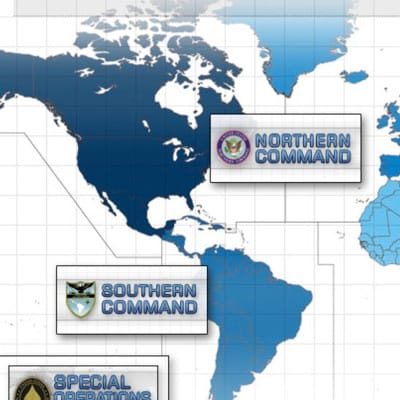
The existing division between U.S. Southern Command (SOUTHCOM) and U.S. Northern Command (NORTHCOM) creates exploitable gaps that adversarial entities readily utilize. A unified, threat-centric command—tentatively named USAMERICOM—could eliminate these geographic constraints, aligning operational focus on transnational threats such as:
- Criminal Networks
- State-Sponsored Influence
- Cyber Activities
- Mass Migration
Such integration would enhance strategic clarity, streamline authority lines, and foster collaborative efforts across North, Central, and South America, ultimately achieving greater operational impact at reduced expenditure.
Addressing Vulnerabilities in Command Structures
It is a recognized military principle that adversaries exploit gaps, particularly in areas where operational units or command frameworks converge. This vulnerability necessitates continuous coordination and has been evident not only in tactical scenarios, like those observed in Ukraine, but also at an operational level where different combatant commands overlap.
The military’s ability to secure vital channels into a battlespace is paramount to denying adversaries maneuverability. If operational seams are weak, adversaries can exploit these vulnerabilities, as illustrated by the historical challenges faced in both Vietnam and more recently in Ukraine regarding logistics and supply lines.
Responsibilities Under Current Commands
- NORTHCOM focuses on:
- Homeland defense
- Civil support
- Arctic operations
- Counterterrorism coordination
- SOUTHCOM is concentrated on:
- Counter-narcotics initiatives
- Stability operations
- Partner engagement
- Humanitarian assistance
Despite appearing distinct on paper, security threats in the Western Hemisphere are not confined by these arbitrary geographic lines. While intra-command coordination exists, the structural divide impedes a cohesive response to multifaceted threats.
Operational Inefficiencies
SOUTHCOM’s JIATF-South and Joint Task Force Bravo serve specific roles effectively but lack the integrated authority necessary to counteract hemispheric networks effectively. Additionally, the Coast Guard often takes the lead in operational missions but is constrained by divided responsibilities and fragmented command relationships.
This operational gap has immediate and impactful consequences. For instance, in 2023, the U.S. managed to interdict only 11 percent of the estimated 1,800 metric tons of cocaine targeted at its shores. With much of this illicit flow originating from South America, transnational criminal organizations exploit these command divisions. In 2022, although SOUTHCOM identified over 4,500 suspected smuggling incidents, they could respond to just 27 percent due to capacity limitations, while NORTHCOM often cannot act until threats reach its jurisdiction.
The situation is analogous in the realm of human trafficking. Extensive networks facilitate migration from Venezuela and the Caribbean through sites like the Darién Gap into Mexico. In FY2023, CBP reported over 2.4 million encounters with migrants at the southern border, many aided by criminal entities—often too late for effective intervention.
Reinvigorating U.S. Influence in the Hemisphere
This current command structure also hampers efforts to re-establish U.S. influence, providing openings for adversarial nations like China and Russia. These nations are employing economic coercion, disinformation campaigns, and military collaborations to undermine democratic governance across the hemisphere. With China gaining control over crucial infrastructure in Panama, Jamaica, and the Bahamas—most notably the Panama Canal—it’s clear that a cohesive command is necessary to counter growing threats to U.S. interests.
Reform Initiatives: Towards USAMERICOM
The directives of combatant commands are outlined in the Unified Command Plan, yet these delineations often reflect bureaucratic rather than strategic reasoning. Alterations to this plan should prioritize mission effectiveness over artificial borders, as demonstrated by historical realignments like relocating Israel from EUCOM to CENTCOM.
Benefits of Consolidation
- Elimination of Redundancies: Streamlining command structures would minimize bureaucracy and enable swifter decision-making.
- Resource Optimization: Merging NORTHCOM and SOUTHCOM would enhance leadership cohesion and improve resource allocation.
- Enhanced Operational Synergy: Unifying components such as U.S. Army North and U.S. Army South would amplify efficiencies.
USAMERICOM could integrate existing assets, including Alaskan Command, JTF-North, JTF-South, JTF-Bravo, and JIATF-South, creating a more manageable command structure while maximizing effectiveness.
Strategic Alignment and Diplomatic Engagement
A unified command would establish a strong strategic profile distinct from the combat-centric focuses of CENTCOM or INDOPACOM, providing a wide-ranging mission scope. The Coast Guard could take a leading role within this framework, leveraging its existing expertise in interagency coordination for homeland defense initiatives.
Furthermore, a consolidated command would facilitate improved diplomatic relations. Currently, disparate commands create fragmentation; an integrated USAMERICOM would fortify partnerships and improve security cooperation across the region against adversarial pressures.
Overcoming Challenges
Despite the evident strategic advantages, political and bureaucratic pushback is likely. Both Congressional and military stakeholders may resist such a structural change due to concerns over command authority and potential operational disruption. Transitioning to a unified command would necessitate meticulous planning and active engagement with relevant agencies.
Preserving focus on high-stakes threats, particularly in the Arctic region, must remain a priority. One potential solution is to establish NORAD as a standalone entity within USAMERICOM to maintain its strategic focus while also enhancing broader regional operations.
Conclusion
China and Russia are treating the Western Hemisphere as a unified operational theater. Maintaining separate commands only perpetuates a fragmented approach. A consolidated USAMERICOM would effectively close operational gaps and foster a more coherent strategy, aligning homeland security with transnational realities.
Transforming NORTHCOM and SOUTHCOM into USAMERICOM is more than a bureaucratic adjustment; it is an imperative to establish a comprehensive defense posture. Such a cadre would enable proactive interruptions of intercontinental threats—intelligence integration, and heightened collaboration, ensuring the U.S. can swiftly adapt to emerging challenges in its own strategic backyard.