European Defense Tenders and Corruption

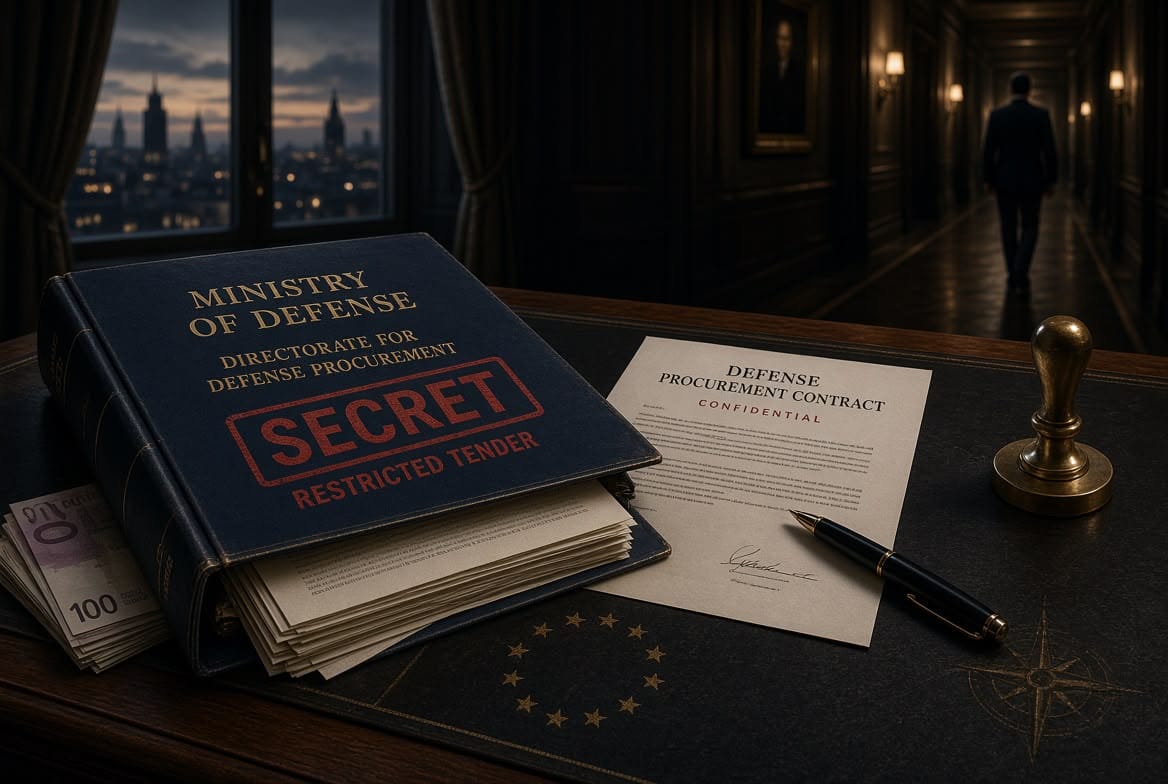
Europe is pouring record sums into weapons. The same governments still run many of those purchases through closed tenders, favoured intermediaries, and officials who see the bid list before the market does.
That combination - secrecy, urgency, and money - is where corruption and tender manipulation live.
The pattern is structural, not exotic. Defense is already the least competitive corner of public contracting. Restricted procedures, negotiated deals, and single-source awards are routine. Older Transparency International assessments found open competition almost absent in parts of Central and Eastern Europe: in Lithuania, open tenders were a rounding error; in Poland, secret or single-source routes accounted for a large share of defense processes. Across the EU, military contracts score higher on corruption-risk indicators than ordinary public contracts.
The methods are familiar: specifications written for one bidder; information leaked before the tender drops; a "trader" inserted between factory and ministry so the price jumps; contracts re-awarded to firms that have already failed to deliver.
OLAF, the EU's anti-fraud office, has called the rearmament wave a magnet for exactly this: rigged tenders, inflated prices, clientelism. More money, more cases.
Inside EU and NATO Countries
Germany
A Bundeswehr officer at the defense ministry was suspended after allegedly passing a classified list of more than 150 planned purchases later reported as hundreds of billions of euros in potential spend, including named contractors to an arms lobbyist. That is tender manipulation at the source: the buyer's pipeline becomes a private briefing.
Estonia
The defense minister resigned in September 2026 after auditors flagged ministry irregularities and a €70 million ammunition package, paid in advances from the EU Peace Facility to an Italy-registered firm that did not deliver as promised. EU prosecutors took the case. Opposition parties alleged conflicts of interest and missing files. Frontline state, EU money, closed process: the political cost arrived anyway.
Croatia
The large buys stay classified; the small ones leak the method.
The usable evidence of manipulation sits on the kit soldiers wear and the events the ministry stages: favoured firms, unpublished contracts, brokers standing in front of factories.
Until the Croatian government publishes every award above a low threshold, names beneficial owners, and ends "simple" deals that cannot be appealed, Croatian defense tenders will keep being decided the way the boot file was: by who sits in the procurement sector, not by who makes the better kit.
NATO's Luxembourg-Based Buying Arm - NSPA
Belgian and Dutch investigators detained current and former staff over alleged leaks of contract information on ammunition and drones, kickbacks, and consultancy shells used to move money. The probe reached Italy and Spain.
Alliance procurement is not a clean room.
That is classic tender distortion, and European companies sit in the middle of it.
What "Manipulation" Looks Like in Practice
- Leak the requirement list so one lobbyist can price and position first.
- Restrict the field so only insiders can bid.
- Route a factory product through a shell that marks it up 20-30 percent.
- Re-select a defaulting contractor because the relationship outranks performance.
- Classify the file so parliament and auditors see the press release, not the annex.
None of this requires a failed state. It requires classified annexes, revolving-door consultants, and political pressure to "just buy."
The Cost Is Readiness, Not Only Headlines
Every rigged tender either pays too much, delivers late, or delivers the wrong kit.
At the scale Europe has now committed extra defense effort on the order of 2 percent of EU GDP, small percentage leaks become real battalions that never form. Anti-corruption groups told Munich Security Conference audiences in 2026 the same thing: governance failure is a capability failure.
The fix is not slower rearmament. It is published awards, named beneficial owners, hard caps on single-source justifications, cooling-off rules for officials who become brokers, and audit access that classification cannot veto.
Until those rules are the default, European defense tenders will keep being won the old way: by the people who saw the file first.