Expodefensa 2025: Czech Ultra-Light Machine Gun DSS PZD Mk24 Aims for International Markets

Analyzing the PZD Mk24: A Leap Forward in Light Machine Gun Design
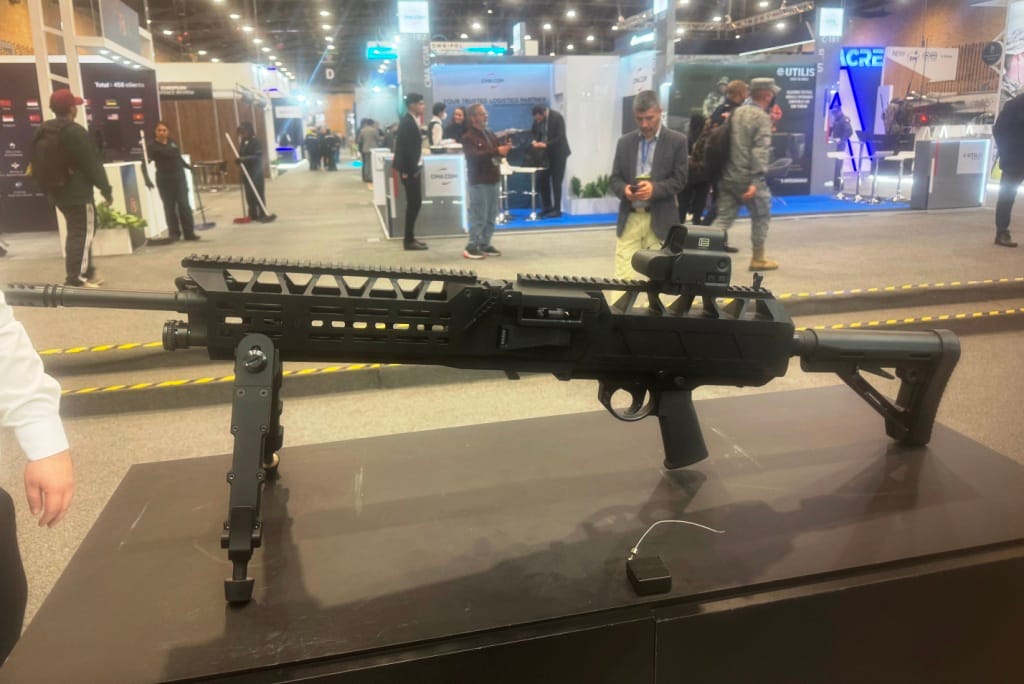
The PZD Mk24, an ultra-light 5.56 mm light machine gun developed by Czech firm DSS, has made a significant impression both in Europe and on the international defense stage, notably at the recent ExpoDefensa in Colombia. This unveiling not only illustrates DSS’s ambition to penetrate new markets but also showcases the Mk24’s capability to serve military forces beyond its geographic origin.
DSS: A Rising Name in Defense Manufacturing
Based near Prague, DSS a.s. is a relatively new entity in the defense sector, specializing in advanced manufacturing techniques such as CNC machining and welding. Known primarily for producing high-quality Minimi-type light machine guns, DSS has emerged as the second-largest small-arms manufacturer in the Czech Republic. The PZD Mk24 represents the company’s inaugural original design, aiming to establish DSS as a formidable competitor in the global small-arms arena.
The Mk24 was first revealed at the Vietnam Defence Expo (VIDEX) 2024 and has continued to gain traction at subsequent international defense exhibitions. The marketing strategy effectively emphasizes the weapon’s reduced weight, manageable recoil, and modern user ergonomics, targeting both domestic markets and foreign clients looking for replacements for outdated 5.56 mm systems.
Technical Specifications and Operational Versatility
Chambered for the NATO-standard 5.56×45 mm cartridge, the Mk24 employs a long-stroke gas piston mechanism equipped with an adjustable gas regulator. This feature ensures consistent reliability across a range of ammunition types and diverse operational conditions. The overall weight of the weapon has been minimized by approximately 30%, with combat weight estimated between 5.2 kg and 6.2 kg, depending on the configuration.
The Mk24 offers dual firing modes—semi-automatic and fully automatic—via a select-fire trigger. This versatility allows operators to engage targets with precision or deliver sustained fire as mission requirements dictate. Notably, the weapon’s quick-change barrels, available in roughly 14 and 16 inches, afford tactical flexibility, adapting to close-quarters or extended-range engagements.
Key Features:
- Lightweight Design: Reduces user fatigue and enhances maneuverability.
- Adjustable Gas System: Adaptable to various ammunition and environmental conditions for increased reliability.
- Modular Components: Quick-change barrels for attentive role transitions.
- Extensive Rail System: Continuous Picatinny rail optimized for mounting optics and attachments while preserving zero.
Performance Metrics
Open-source reports suggest that the effective range of the Mk24 is approximately 600 meters, with a maximum suppression range extending to 1,200 meters. The weapon’s carefully engineered weight distribution, paired with its tuned gas mechanism and recoil-mitigating design, facilitates superior accuracy during automatic fire, distinguishing it from older 5.56 mm systems.
In terms of tactical applications, the Mk24’s design empowers infantry squads to deliver high volumes of suppressive fire without the bulk typically associated with conventional “light” machine guns. Its compact dimensions and assault rifle-like ergonomics make it particularly well-suited for Special Forces, mechanized infantry, and Marines who operate in complex urban environments.
Tactical Applications and Future Prospects
The Mk24 transcends traditional roles by enabling modular setups for varied applications, including patrol, defensive overwatch, or vehicle-mounted scenarios. This adaptability is supported by its capacity to incorporate optics, night vision devices, and additional grips as required. By combining the capability for accurate single shots and sustained fire over several hundred meters, the Mk24 seeks to bridge operational gaps between individual rifles and conventional machine guns within modern infantry tactics.
DSS has actively showcased the Mk24 at various international defense exhibits, targeting a broader export market beyond Central Europe. Evidence from open channels indicates that the weapon has been supplied to Ukrainian forces, including Special Forces and Marines, where it has undergone real-world operational testing.
However, large-scale integration into NATO forces remains largely unverified, with initial exports primarily reaching early adopters and evaluation units rather than comprehensive re-equipment initiatives. Nevertheless, ongoing trials, plans for an even lighter aluminum receiver version, and persistent visibility at defense forums suggest that DSS is poised to pursue broader export contracts.
Conclusion
The PZD Mk24 represents a significant evolution in light machine gun technology, combining innovative design with operational adaptability suitable for diverse combat environments. As DSS continues to expand its influence worldwide, the Mk24 stands as a testament to the potential of new entrants in a historically consolidated industry, challenging established norms and reshaping the landscape of infantry firepower.