PAS 2025: Schiebel Reveals Enhanced Specifications for the Camcopter S-300 UAV

Advancements in UAV Technology: The Camcopter S-300 Unveiled
Overview of the Camcopter S-300
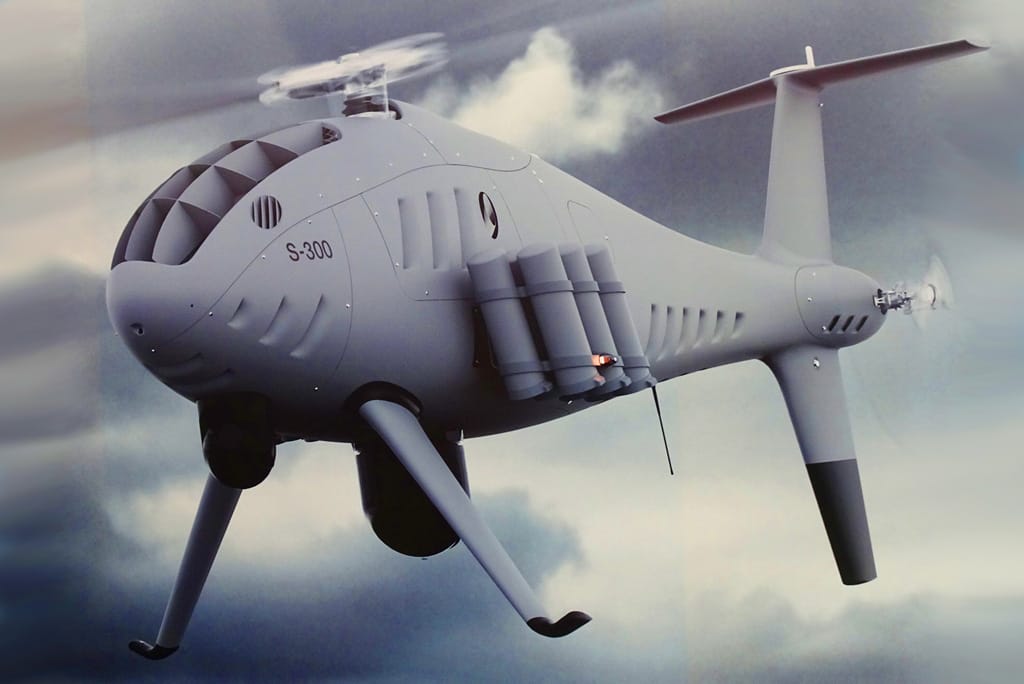
At the recent Paris Air Show, Schiebel, an Austrian aerospace manufacturer, showcased the upgraded specifications of its Camcopter S-300 unmanned aerial vehicle (UAV). This model represents an expanded variant of the well-regarded Camcopter S-100, a vertical takeoff and landing (VTOL) platform that has already established a significant presence in the international defense market. Essential for military applications, the S-300 incorporates enhanced capabilities aimed at meeting the evolving demands of modern warfare.
Specifications and Performance Metrics
The S-300 boasts a maximum takeoff weight of 660 kg, with a dry weight of approximately 320 kg. This configuration allows for 340 kg of capacity allocated for fuel and sensor payloads:
- Fuel Capacity:
- Equipped with a 300-liter fuel tank.
- At maximum range operations, it can support 250 kg of fuel, leaving 90 kg available for various sensors.
- Endurance:
- With a full fuel load, the S-300 achieves an impressive 24-hour flight duration.
- Depending on operational needs, users can adjust the balance between endurance and payload, accommodating missions down to 6-hour limits with a potential payload of 250 kg.
Dimensions and Technical Features
The Camcopter S-300 is optimized for various military applications, with dimensions that enhance its operational versatility:
- Length: 4,850 mm
- Height: 1,890 mm
- Width: 900 mm
- Rotor Diameter: 5,300 mm
Powering the UAV is a heavy-fuel aviation engine compliant with NATO’s single-fuel policy, able to utilize fuels like Jet A-1, JP-8, and JP-5. Key performance attributes include:
- A maximum speed of 220 km/h and a cruising velocity of 100 km/h.
- Operating altitudes reaching up to 6,400 meters.
- Capability to execute takeoffs and landings in wind conditions up to 46 km/h and in sea states up to 5.
- Data link range extending to 200 km.
Enhanced Commonality and Training Efficiency
A significant advantage of the S-300 lies in its high degree of commonality with its predecessor, the S-100. This design feature significantly reduces the training requirements for operators transitioning to the new model, thereby facilitating a smoother integration process into existing military operations.
Future-Ready Capabilities
To broaden the operational scope of the Camcopter S-300, Schiebel intends to integrate satellite communications. This addition will allow for missions that extend beyond line of sight, increasing the UAV’s utility in complex operational environments.
Advanced Sensor and Warfare Applications
Compared to the S-100, the Camcopter S-300 is engineered to support advanced radar systems. These enhancements provide improved surface target detection, making the platform particularly appealing for military forces seeking superior reconnaissance capabilities. Moreover, the UAV can accommodate up to eight hydroacoustic buoys, expanding its potential for anti-submarine warfare missions.
Logistics and Deployment
The design incorporates a triple-blade folding rotor system, which permits efficient storage and transport. Notably, it allows for two S-300 UAVs and a Ground Control Station (GCS) to fit conveniently into a standard 20-ft container, enhancing logistical flexibility for deployment in various theaters of operation.
By embracing innovative design and advanced technology, the Camcopter S-300 positions itself as a formidable addition to the portfolio of military UAVs. Its specifications and features offer robust solutions for contemporary challenges in airborne reconnaissance, anti-surface warfare, and anti-submarine operations.
Images used courtesy of Schiebel.