Rheinmetall ROSY: Vertical Defense Solution for Last-Minute Drone Protection

Advancements in Counter-Drone Technologies: The ROSY System by Rheinmetall
The Unfolding Drone Threat Landscape
The proliferation of unmanned aerial vehicles (UAVs) represents an escalating risk on modern battlefields. Defense corporations globally are urgently seeking solutions to counter these emerging threats, with some firms, such as Rheinmetall, engaged in developing both offensive drone capabilities and protective measures against them. This dual approach reflects an adaptive strategy to address dynamic aerial threats.
Rheinmetall’s Innovative Countermeasures
One notable development in Rheinmetall’s arsenal is the Rapid Obscuring System (ROSY). Showcased recently at the Rheinmetall Mobility Days 2025, held in Vienna, this system exemplifies the company’s commitment to integrating defense technologies that enhance operational survivability.
System Features and Capabilities
ROSY is designed to produce tactical smoke screens for armored vehicles, effectively disguising their movements. The key features include:
- Dynamic Smoke Creation: Generates smoke under operational conditions, providing concealment for both static and mobile units.
- Launcher Variability: Two types of modular launchers are available: the 1M, 2M, and 3M variants, each capable of housing five 40mm grenades. The ROSY_Mod offers a single-tube solution, minimizing installation footprint while maximizing flexibility.
- Integrated Control: The manual control unit (MCU) manages up to four launchers, connecting through CAN-bus/Ethernet interfaces for enhanced operational awareness. Users can select the firing mode and type of ammunition, adapting to various tactical scenarios.
Application Beyond Traditional Defense
In a bid to address aerial reconnaissance and potential attack vectors posed by hostile drones, Rheinmetall has explored leveraging the ROSY ammunition for aerial obfuscation. Each 40mm smoke round comprises:
- Delay Activation: Smoke deployment occurs 0.5 seconds after launch, reaching maximum effectiveness in both visible and infrared spectrums within 1.5 seconds, providing valuable time for evasive maneuvers.
- Multi-Spectrum Coverage: The smoke also obscures thermal signatures, rendering vehicles less detectable to advanced imaging systems.
Enhanced Aerial Defense: The ROSY Vertical Launch
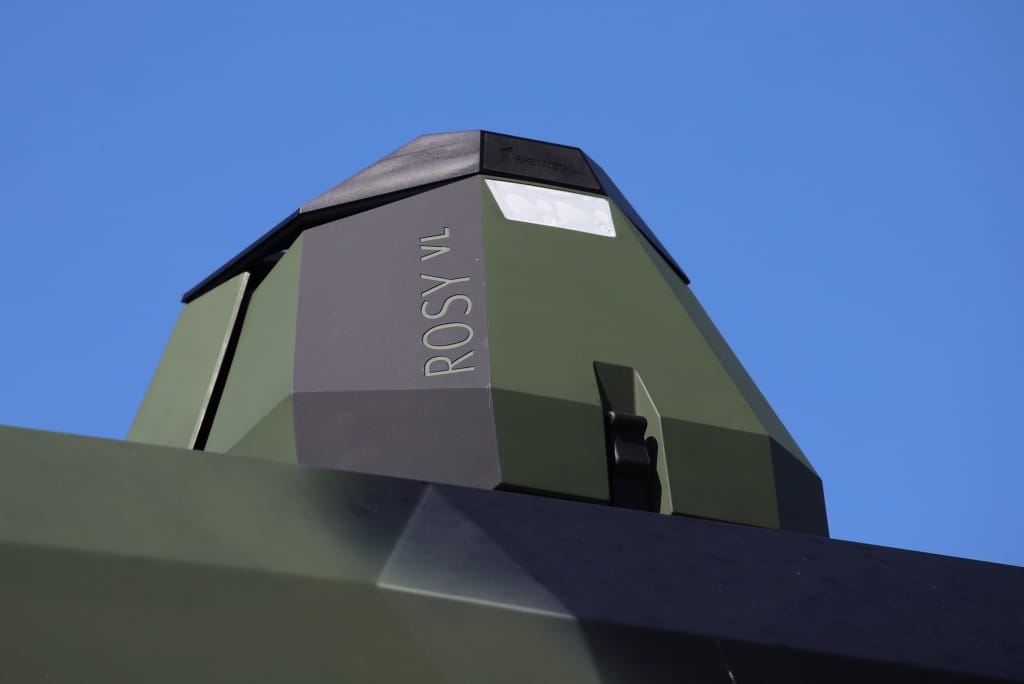
Responding to the escalating threat landscape, Rheinmetall has advanced the ROSY system into a specific aerial defense mechanism: the ROSY Vertical Launch (ROSY_VL). This configuration installs ten launchers in an upright formation, enabling a rapid succession of smoke grenades to forge a protective cloud.
Strategic Integration
- Heightened Smoke Coverage: By launching grenades to an altitude of approximately 100 meters, the ROSY_VL can create a hemispherical smoke barrier, obstructing drones’ line of sight and their reconnaissance capabilities.
- Versatility of Use: Installed at elevated angles, the smoke cloud can provide critical cover, allowing armored vehicles to execute evasive maneuvers while maintaining operational integrity.
Expanded Capabilities
As a hybrid solution, the ROSY system not only obscures but may also incapacitate smaller, commercially available drones through incendiary effects, thanks to its payload composition. This approach allows the system to function as both a soft and hard kill mechanism.
Current Status and Future Developments
Currently, Rheinmetall is finalizing the ROSY_VL’s development, classified at a Technology Readiness Level (TRL) of 6/7. The initial tenets of this defense system stem from Rheinmetall Waffe Munition’s facilities located in southern Germany. Interestingly, while the present ammunition utilized is standard smoke grenades, demand from military stakeholders may influence future iterations of more specialized UAV countermeasures.
Considerations for Future Integration
Rheinmetall has yet to interface the ROSY with automated detection systems for incoming aerial threats, which remains a consideration for enhancing the system’s effectiveness. Challenges persist in rapidly identifying and countering UAVs from within an armored vehicle’s confines, necessitating a user-friendly integration of low-cost warning systems.
Conclusion
As military forces increasingly confront drone challenges, Rheinmetall’s ongoing innovations in counter-drone capabilities exemplify the necessity for adaptive defense technologies that can seamlessly integrate into existing platforms. With systems like ROSY and its vertical launch variant at the forefront, the enhancement of tactical survivability against aerial threats is both a priority and an imperative within modern defense strategies.