UDT 2025: Introducing the Euroatlas Greyshark Series 2 Foxtrot - A Breakthrough in Autonomous Underwater Technology

Unveiling the Greyshark Series 2 Foxtrot: The Next Generation of Autonomous Underwater Vehicles
At the prestigious Euronaval 2024 exhibition in Paris, attendees were introduced to a groundbreaking innovation in the world of autonomous underwater vehicles (AUVs): the Greyshark Series 2 Foxtrot, developed by Euroatlas, a pioneering German manufacturer. Following its debut, the AUV is set to be showcased in March 2025 at the UDT conference in Oslo, highlighting its capabilities in reconnaissance, surveillance, and the safeguarding of underwater infrastructures.
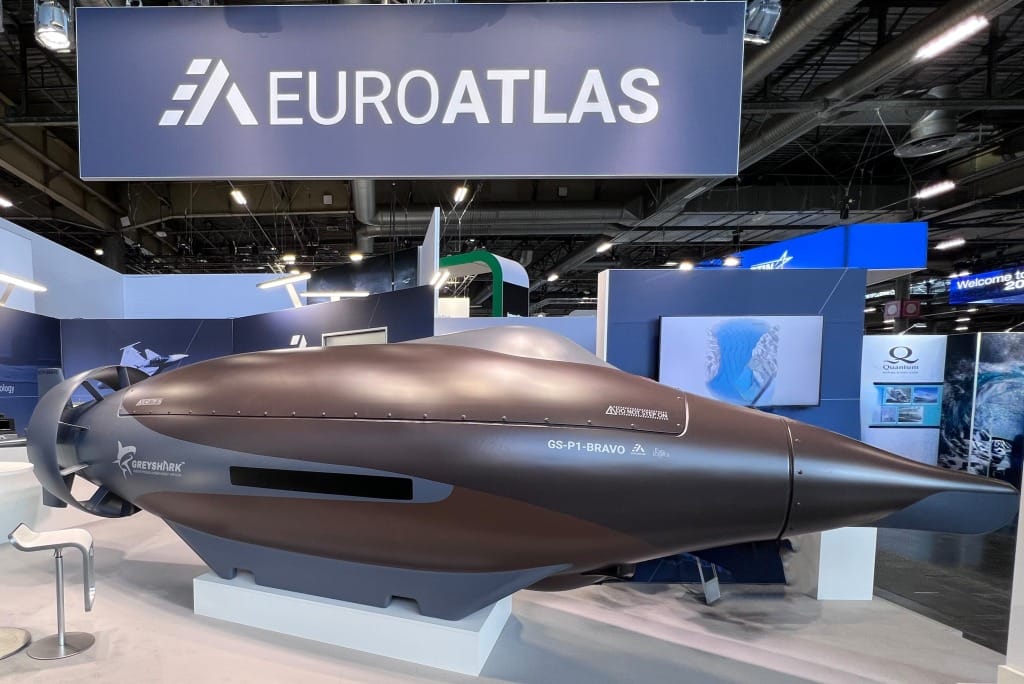
The Greyshark Series 2 Foxtrot boasts an impressive hydrodynamic design, measuring 7.99 meters in length and 1.8 meters in diameter, with a total mass of 4.5 tonnes. Constructed from composite materials, its design minimizes electromagnetic signatures and water disturbance, making it exceedingly challenging to detect. One of the most significant advantages of the Greyshark is its quiet, electric propulsion system, based on a sophisticated non-permanent magnetic electric ring motor that drives a segmented ring rotor propeller. This design endows the vehicle with extreme dive capabilities—allowing for nearly vertical descents—and a notably small turning radius. It operates at speeds of approximately 10 knots, with maximum speeds exceeding this threshold based on operational conditions.
click on image to enlarge
One of the most compelling features of the Greyshark Series 2 Foxtrot is its endurance. The AUV is equipped with a fuel cell system that provides an impressive operational range of 1,100 nautical miles (NM) or five days at operational speed. Notably, by adjusting its speed, such as reducing to 4 knots, the Greyshark can extend its endurance to an astounding 10,700 NM and 16 weeks, demonstrating remarkable versatility in mission adaptability.
Communications and control are also paramount in the Greyshark’s design. The front of the hull houses Ultra-Short BaseLine (USBL) acoustic antennas, which facilitate swarm encrypted acoustic communications. The rear-mounted telescopic antenna system ensures reliable LTE (Long Term Evolution) and L-band communications, complemented by a GNSS receiving antenna. To enhance situational awareness, the starboard side is equipped with advanced side-scan synthetic aperture sonar (SAS), providing ultra high-resolution imagery essential for reconnaissance missions.

Underneath the AUV, advanced sensor integration plays a crucial role in operational effectiveness. Beginning with the bow, the vehicle incorporates a front-facing multibeam sonar with dual elements, enhancing obstacle detection and collision avoidance. Following this are various specialized sensors, including acoustically sensitive radomes, depth sensors, and a wide-band multibeam sonar that generates high-resolution images of the seafloor. The Phins Subsea integrated inertial navigation system, supplied by Exail, includes a doppler velocity sensor to optimize navigation accuracy.

Data collected by the Greyshark’s extensive sensor suite undergoes sophisticated analysis through sensor fusion, enabling the vehicle to operate autonomously for extended periods without human oversight. The AUV can maintain communication with its base only when it identifies critical events, such as potential intrusions or threats to vital underwater infrastructure. The addition of Artificial Intelligence (AI) enhances the Greyshark’s operational independence, facilitating automated target recognition and mission adaptability.

The Greyshark is engineered to support numerous mission types, from seabed surveillance and submarine shadowing to inspecting significant underwater objects. Its ability to operate passively or actively allows for persistent monitoring without needing significant manpower, a particularly valuable trait given the recent incidents that have raised awareness about underwater security. The AUV is capable of diving depths of up to 650 meters, with expandable capabilities reaching 4,000 meters for specialized missions.
One of the defining aspects of the Greyshark Series 2 Foxtrot is its operational autonomy, enabling deployment farther from a home base with minimal logistical support. The AUV can be transported in a standard 40-foot container, which can be easily moved by truck, train, ship, or airplane. Additionally, a second container serves as a charging and refueling station, streamlining the process with partly automated refill protocols.
Currently undergoing rigorous testing phases, the Greyshark Series 2 Foxtrot is expected to expand its capabilities by 2026, with enhancements in dive durations and AI integrations. The project is closely aligned with European initiatives such as SWARMS (Smart and Networking underWAter Robots in cooperation MeShes) and SALSA (Smart Adaptive Long- and Short-range Acoustic network), which aim to standardize communications between underwater drones. With its cutting-edge stealth, autonomy, and modular capabilities, the Greyshark stands poised to become an indispensable asset to modern naval forces responding to underwater security threats.
According to Euroatlas, the Greyshark AUV is designed for a wide array of missions, including the protection of underwater infrastructure through proactive surveillance of vital cables and energy platforms, mine warfare operations for autonomous mine detection and neutralization, and potential anti-submarine strategies employing targeted sonar missions with active decoys. Each of these applications underscores the Greyshark’s role in modern underwater warfare, shaping a new frontier in the domain of maritime security.
Photo and images courtesy Euroatlas