Ukraine Expands Its Strategy Beyond Attack Drones to Engage in Comprehensive Robot Warfare

The Evolution of Robotics in Warfare: Insights from the Ukrainian Experience
Transformative Impact of Drones
Recent footage captured by the Ukrainian military’s first-person view (FPV) drones has piqued significant interest, but these images represent merely the surface of a profound shift towards robotic integration in combined-arms operations. Jack Watling, a senior research fellow in land warfare at the Royal United Services Institute (RUSI), explores this evolution in a comprehensive analysis, illustrating how Ukraine’s strategic approach to robotics is redefining modern warfare.
Emergence of Ukrainian Robotic Doctrine
Watling’s analysis details the trajectory of Ukraine’s robotic warfare strategy, evolving from basic reconnaissance functionalities to intricate operations involving both aerial and terrestrial drones. This transformative approach coordinates the movements of unmanned systems that adeptly traverse the battlefield alongside human forces.
Necessity Drives Innovation
The impetus for this shift arose from imperative circumstances. Watling articulates the disruption of military-technical support due to political developments in Washington, which led Ukraine to pivot strategically towards drones—a method both controllable and effective. The establishment of dedicated UAV regiments, alongside non-conventional brigades, exemplifies Ukraine’s pioneering efforts in deploying novel robotic capabilities.
Redefining Battlefield Geography
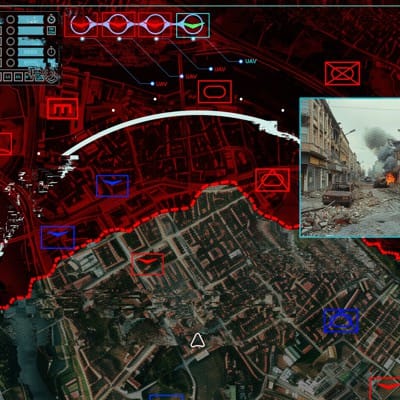
The intensive deployment of drones has fostered a new conceptual framework for understanding the battlefield. Ukrainian and Russian units typically find themselves separated by approximately 15 kilometers of terrain now dominated by armed UAVs. This “grey zone” or “contested zone” renders traditional operational tactics precarious.
- Middle Zone: Approximately an additional 15 kilometers where engagements occur within a broader operational context, focusing on the accumulation of armaments, sensors, and electronic jamming systems.
- Deep Zone: Encompasses logistics centers and production facilities, responsible for future operational support but not directly influencing immediate conflicts.
Tactical Innovations in Grey-Zone Combat
A crucial aspect of gaining control over the grey zone involves isolating adversary forces operating in the middle zone. Ukrainian tactical evolution now includes employing drones to enhance defensive capabilities, such as:
- Laying Mines and Setting Traps: Utilizing UAVs for creating obstacles to inhibit enemy reinforcement.
- Persistent Interdiction Operations: Employing FPV drones to thwart logistical movements.
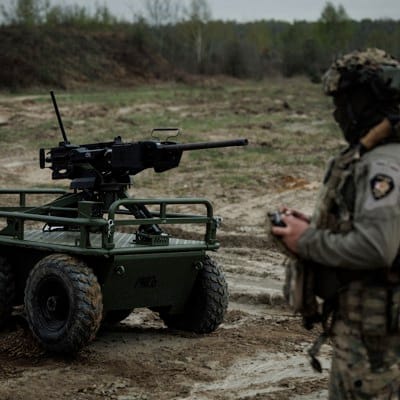
Once adversaries are effectively encircled, Ukrainian forces leverage robotic systems to mount assaults, integrating uncrewed ground vehicles (UGVs) for their sustained firepower, enabling attacks from concealed positions.
Logistics and Resupply: A Robotic Approach
Ukrainian forces, constrained by relatively smaller logistical formations, have adeptly utilized UAVs and UGVs for vital resupply operations. This includes delivering equipment necessary for fortifying positions, illustrating a shift towards leveraging robotic systems in operational logistics.
Strategic Lessons for NATO
Insights from Ukraine’s experiences hold significant implications for NATO members, as discussed in a recent GLOBSEC meeting involving government officials and civilian technological experts. Key points include:
- Adaptation to Modern Warfare: NATO nations are exploring innovative battle-robot concepts, aligning their strategies with the lessons learned from the Ukrainian conflict.
- Countering UAV Threats: Joint exercises testing responses to UAV incursions are underway, emphasizing the need for NATO to maintain operational superiority while supporting Ukraine.
Observations on NATO’s Structure
The war in Ukraine challenges conventional notions surrounding NATO’s operational constructs—indicating that traditional assumptions about secure rear areas are outdated in light of modern drone capabilities. This necessitates:
- Smaller, More Agile Combat Teams: A shift in force composition to enhance responsiveness.
- Delegation of Command: Empowering brigade-level leaders with greater command authority to adapt swiftly to changing combat dynamics.
Addressing Equipment Vulnerabilities
Watling emphasizes that the rise of drone warfare exposes unforeseen vulnerabilities within existing military assets. For instance, vehicles with inadequate protection (e.g., rubber tires) may prove detrimental in combat scenarios. Military planners should prioritize procuring modular equipment to facilitate rapid repairs in the field.
The Challenge of Institutional Resistance
Despite clear lessons to be drawn, there is a notable lack of urgency among NATO leadership regarding institutional adaptation. While Ukraine’s defense landscape has spurred rapid innovation due to necessity, NATO allies possess larger resources but face challenges in decisively altering their acquisition processes.
- Investment Strategies Misalignment: A reliance on established suppliers hampers adaptation to emerging technologies.
- Coordination and Information Sharing: NATO must elevate its command-and-control mechanisms, integrating human and robotic systems under electronic threat conditions.
As NATO members commit to increasing defense budgets by 2029, the focus should pivot from large procurements to fostering innovative entities specialized in robotics and unmanned technologies. This shift is essential for maintaining operational relevance in an evolving battlefield landscape.