USS Boxer: The Second Amphibious Assault Ship Deployed to the Middle East

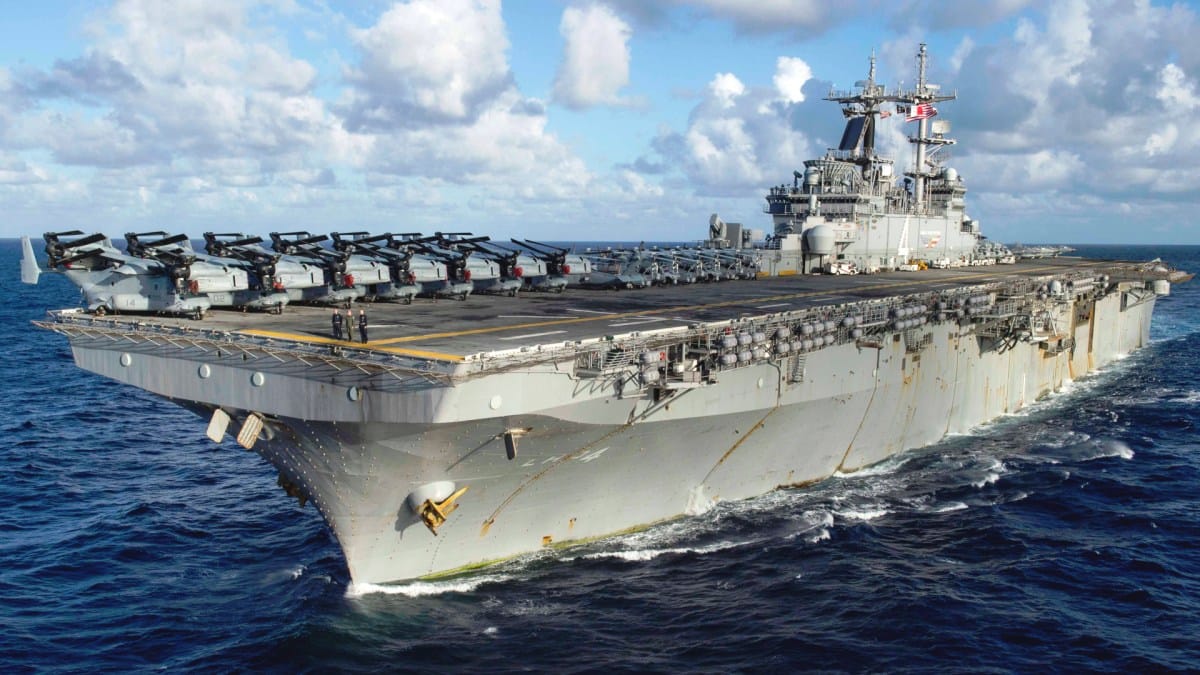
Deployment of USS Boxer Amphibious Ready Group Amid Heightened Tensions in Iran
Overview of Military Movements
The Pentagon has initiated the deployment of the USS Boxer, an amphibious assault ship of the Wasp class, alongside its Amphibious Ready Group (ARG), which includes elements of the 11th Marine Expeditionary Unit (MEU). This strategic maneuver comes as the current administration assesses the implications of potentially seizing—or blockading—Iran’s vital Kharg Island, a critical nexus in the Persian Gulf, as part of a renewed phase dubbed Operation Epic Fury.
Strategic Context of Operation Epic Fury
Recent reports indicate that the accelerated deployment of the Boxer ARG, which embarked from the West Coast, directly supports ongoing operations against Iran. The heightened military posture aligns with a broader strategy aimed at stabilizing the Strait of Hormuz, through which approximately 20% of the world’s oil transits.
- The Boxer ARG includes:
- USS Portland (San Antonio-class)
- USS Comstock (Whidbey Island-class)
The 11th MEU, consisting of roughly 2,500 personnel, integrates both air and ground forces to enhance operational capabilities.
Recent Developments on Kharg Island
Current intelligence suggests potential plans by the U.S. administration to establish a blockade around Kharg Island, heavily relied upon by Iran for oil exports. Such actions might serve to heighten pressure on Tehran and facilitate the reopening of critical maritime passageways.
Key considerations include:
- A naval blockade could be easier to implement initially but may invite retaliatory strikes from Iranian forces, with potential involvement of asymmetric warfare tactics such as drone attacks and anti-ship missiles.
- An occupational strategy targeting Kharg Island would necessitate significant military resources, presenting various operational risks, including proximity to Iranian mainland defensive capabilities.
Escalation of Military Engagement
The military conflict has already seen extensive U.S. airstrikes targeting Iranian military infrastructure, with recent attacks reported on Kharg Island aimed at destroying naval mine storage and missile facilities. Such engagements signify a considerable escalation in hostilities, raising prospects for further operational intensification.
Furthermore, airstrikes conducted on strategic locations, such as the Karaj ballistic missile plant, underscore the urgent objective of neutralizing threats posed by Iranian missile capabilities. Notably, recent satellite imaging and publicly available intelligence confirm the execution of strikes targeting Iranian naval assets, indicating a systematic approach to dismantling Iran’s military readiness.
Implications for Regional Stability
Ceasing Iranian access to Kharg Island could destabilize the regime by inhibiting oil revenue crucial for its financing. This may inadvertently foster internal unrest, as any successor government would encounter significant operational challenges in restoring oil production.
However, the ramifications of a full-scale invasion or blockade extend beyond immediate military goals. The logistical requirements and risks associated with amphibious operations in the Persian Gulf necessitate careful consideration of U.S. maritime assets’ vulnerability during transit and engagement.
Summary of Regional Military Dynamics
As additional U.S. forces, including the USS Tripoli and the 31st MEU, converge on the Middle East, clarity regarding the next phase of Operation Epic Fury is anticipated.
Engagement Updates:
- Casualty Reports: Recent developments have included the reported death of significant Iranian military figures, signaling a shift in the operational landscape.
- Air Defense Alerts: Regional allies, including Israel and Kuwait, have heightened their air defenses in response to Iranian missile threats, revealing a tightly interconnected security environment.
- Drone Attacks: Multiple drone strikes, including directed assaults on energy infrastructures, underscore the shifting nature of warfare in the region, entwining economic targets with military objectives.
In summary, as U.S. forces mobilize and operational plans unfold, stakeholders within the defense sector must closely monitor developments that will shape the geopolitical framework in the Persian Gulf, ultimately affecting global energy markets and security dialogues. Keeping abreast of these shifts is vital for formulating responsive defense postures and strategies.